UTSxIBM

Client Engineering, Enterprise Design Thinking

Context

UTS Design Studio

Timeline

2026, 6 Weeks

Tools

Mural / Miro

Trello

Figma Slides

Deliverables

Research Report

Workshop Facilitation

Final Presentation to IBM

Retaining students through
AI-enabled support

Retaining students
through AI-enabled
support

A student project through UTS Design Practice Studio, partnering with IBM's Client Engineering team, applying their Enterprise Design Thinking (EDT) framework to identify where UTS should effectively innovate with AI.

Through applying the observe, reflect, make loop of EDT, a clear opportunity emerged: international student retention. With current legislation limiting international enrolment growth, the opportunity lies in retaining the students that are already here rather than recruiting more, with AI as the mechanism to intervene before students quietly disengage.


Back to other projects

Project Timeline


Project Timeline


Brief

What opportunity should UTS innovate to ensure their investment drives the right outcomes?

Approach

Using IBM’s Enterprise Design Thinking framework, I approached this problem through three lenses: what is viable for the business, desirable for the user and feasible with technology, to identify where the right innovation opportunity sits for UTS.


The process followed three phases: observing through research and empathy interviews, reflecting by synthesising key insights and making through workshop facilitation and a final playback presented to UTS and IBM.

Process / EDT Framework

Mapping desirability, feasibility and viability to find where the right
innovation opportunity sits for UTS.

Interviewing UTS students that have had experience with the enrollment/dropping out process. Empathy mapping/grouping themes across student interviews.

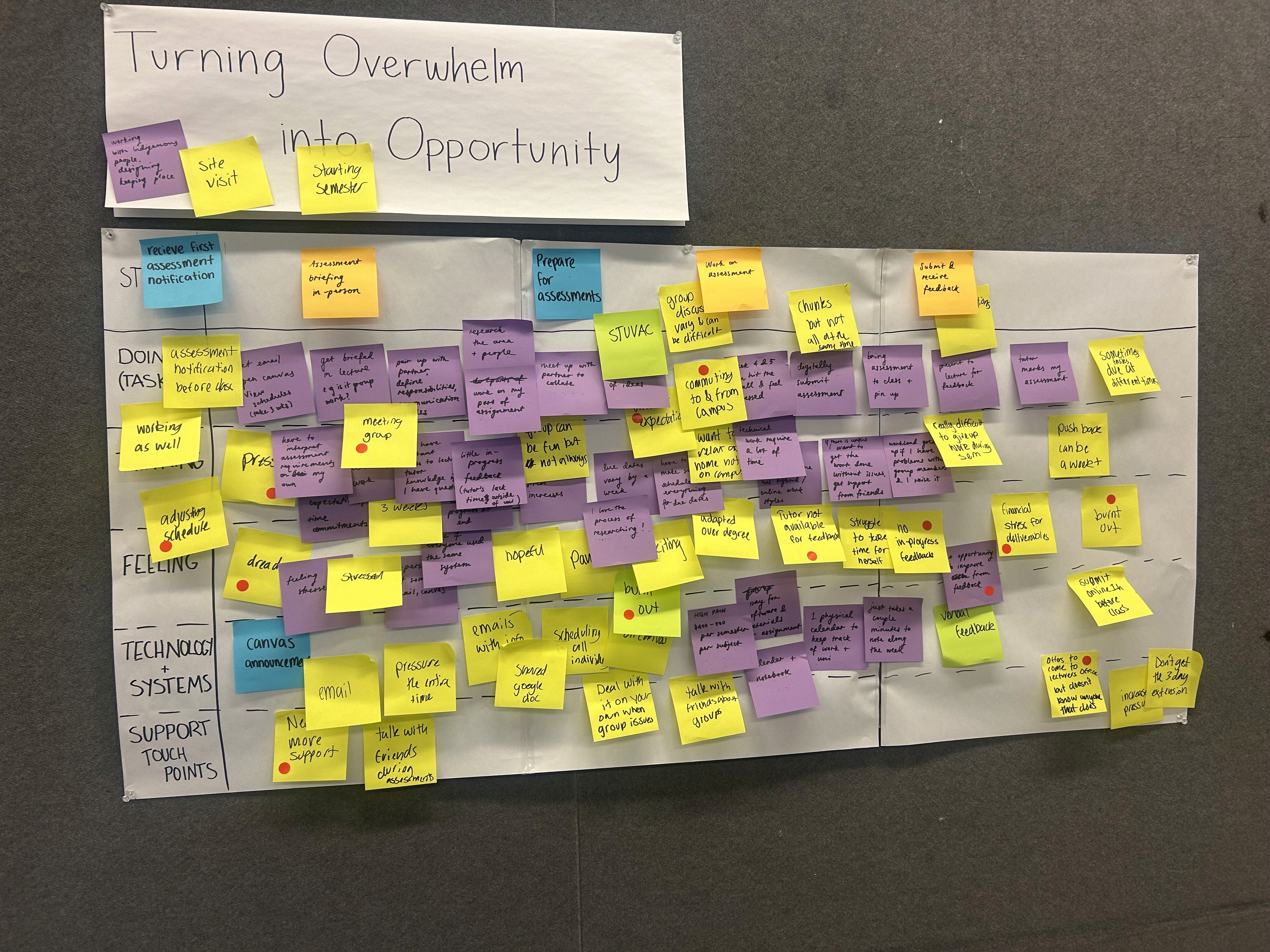
Designing & facilitating a workshop with UTS stakeholders to get a better understanding of their pain points. Mapping international student stress across a semester to find where AI could realistically step in or alert UTS before they disengage.

Presenting to IBM team & UTS stakeholders at IBM head office.

Brief

What opportunity should UTS innovate to ensure their investment drives the right outcomes?

Approach

Using IBM’s Enterprise Design Thinking framework, I approached this problem through three lenses: what is viable for the business, desirable for the user and feasible with technology, to identify where the right innovation opportunity sits for UTS.


The process followed three phases: observing through research and empathy interviews, reflecting by synthesising key insights and making through workshop facilitation and a final playback presented to UTS and IBM.

Process / EDT Framework

Mapping desirability, feasibility and viability to find where the right innovation opportunity sits for UTS.

Interviewing UTS students that have had experience with the enrollment/dropping out process. Empathy mapping/grouping themes across student interviews.

Designing & facilitating a workshop with UTS stakeholders to get a better understanding of their pain points.


Mapping international student stress across a semester to find where AI could realistically step in or alert UTS before they disengage.

Presenting to IBM team & UTS stakeholders at IBM head office.

Insights

What I learnt through the EDT process

What I learnt through the EDT process

01 / DATA

International attrition nearly doubled in one year

Cross-referencing government attrition data with UTS's annual report showed international student attrition nearly doubled in a single year, while domestic retention reached a ten-year high. That gap pointed directly to where UTS's biggest opportunity sat.

02 / RESEARCH

Uni feels temporary

Students often treat uni as something to try alongside part-time work. A drop-out I interviewed left as soon as full-time work came up, since it offered a quicker and more certain path to the career he wanted.

03 / OPPORTUNITY

Retention protects revenue

With new legislation capping international enrolments, every student who leaves represents lost revenue UTS can't easily replace. Supporting the students already here became the most valuable place for UTS to invest in AI.

Designed Outcome

A final playback presentation delivered at the IBM Sydney office
to UTS and IBM stakeholders, synthesising six weeks of research
and workshop insights into a clear opportunity direction and concrete
next steps for UTS to innovate with AI.

Designed Outcome

A final playback presentation delivered at
the IBM Sydney office to UTS and IBM
stakeholders, synthesising six weeks of
research and workshop insights into a clear
opportunity direction and concrete
next steps for UTS to innovate with AI.

LEARNINGS

The best way to approach complex problems is by asking better questions about the people involved and the systems around them.

Workshop facilitation: Designing and running an in-person co-design session with real stakeholders.


Strategic design thinking: Applying IBM's Enterprise Design Thinking framework to a real open-ended brief.


Stakeholder engagement: Presenting 6 weeks of findings and proposals to UTS and IBM, in only 10 minutes.


Empathy-led research: listening to the lived experiences of international students through interviews, then synthesising them into key insights.

Natalie Ellwood Portfolio ©2026

©2026

10:14:15 am